Mortgage Deferrals Now Recorded on Credit Reports

Michael Hallett • July 29, 2020
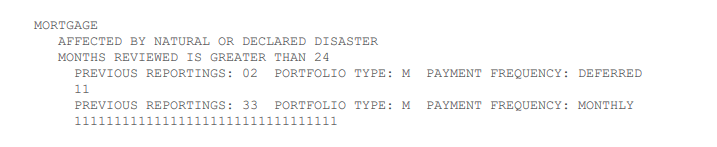
If COVID-19 has negatively impacted your finances and you're currently deferring your mortgage payments, you should know that this will be visible on your credit report. Here is an image from a recent credit report.

In this scenario, it shows that the mortgage was paid as agreed monthly for 33 months before being deferred for the last two months. It also shows that mortgage payments are currently in deferral.


Some may consider the credit bureau reporting a deferred status as good news. As COVID-19 hit like a freight train, many financial experts wondered about reporting errors on credit bureaus as a result of deferred payments. The fact that there is a system in place to report deferrals is a good sign.


Deferring your mortgage payment won't lower your credit score, but reporting errors from deferrals might. Once you've resumed your payments, it's a good idea to get a copy of your credit report to check for errors.


So, why does this matter to me now?


If you're considering a change to your mortgage, most lenders will be very hesitant to consider lending you new money when you aren't able to make your existing mortgage payments. This will be the case if you are looking to move into a new property, renew, or refinance your current mortgage.


So, if changes to your mortgage are on the horizon, it might be a good idea to resume your regular mortgage payments before seeking a new mortgage.


If you'd like to discuss your financial situation with me further, please contact me anytime!


SHARE

MY INSTAGRAM

MICHAEL HALLETT
Mortgage Broker

LET'S TALK
By Michael Hallett January 28, 2026
Bank of Canada maintains policy rate at 2¼%. FOR IMMEDIATE RELEASE Media Relations Ottawa, Ontario January 28, 2026 The Bank of Canada today held its target for the overnight rate at 2.25%, with the Bank Rate at 2.5% and the deposit rate at 2.20%. The outlook for the global and Canadian economies is little changed relative to the projection in the October Monetary Policy Report (MPR). However, the outlook is vulnerable to unpredictable US trade policies and geopolitical risks. Economic growth in the United States continues to outpace expectations and is projected to remain solid, driven by AI-related investment and consumer spending. Tariffs are pushing up US inflation, although their effect is expected to fade gradually later this year. In the euro area, growth has been supported by activity in service sectors and will get additional support from fiscal policy. China’s GDP growth is expected to slow gradually, as weakening domestic demand offsets strength in exports. Overall, the Bank expects global growth to average about 3% over the projection horizon. Global financial conditions have remained accommodative overall. Recent weakness in the US dollar has pushed the Canadian dollar above 72 cents, roughly where it had been since the October MPR. Oil prices have been fluctuating in response to geopolitical events and, going forward, are assumed to be slightly below the levels in the October report. US trade restrictions and uncertainty continue to disrupt growth in Canada. After a strong third quarter, GDP growth in the fourth quarter likely stalled. Exports continue to be buffeted by US tariffs, while domestic demand appears to be picking up. Employment has risen in recent months. Still, the unemployment rate remains elevated at 6.8% and relatively few businesses say they plan to hire more workers. Economic growth is projected to be modest in the near term as population growth slows and Canada adjusts to US protectionism. In the projection, consumer spending holds up and business investment strengthens gradually, with fiscal policy providing some support. The Bank projects growth of 1.1% in 2026 and 1.5% in 2027, broadly in line with the October projection. A key source of uncertainty is the upcoming review of the Canada-US-Mexico Agreement. CPI inflation picked up in December to 2.4%, boosted by base-year effects linked to last winter’s GST/HST holiday. Excluding the effect of changes in taxes, inflation has been slowing since September. The Bank’s preferred measures of core inflation have eased from 3% in October to around 2½% in December. Inflation was 2.1% in 2025 and the Bank expects inflation to stay close to the 2% target over the projection period, with trade-related cost pressures offset by excess supply. Monetary policy is focused on keeping inflation close to the 2% target while helping the economy through this period of structural adjustment. Governing Council judges the current policy rate remains appropriate, conditional on the economy evolving broadly in line with the outlook we published today. However, uncertainty is heightened and we are monitoring risks closely. If the outlook changes, we are prepared to respond. The Bank is committed to ensuring that Canadians continue to have confidence in price stability through this period of global upheaval. Information note The next scheduled date for announcing the overnight rate target is March 18, 2026. The Bank’s next MPR will be released on April 29, 2026. Read the January 28th, 2026 Monetary Report
By Michael Hallett January 21, 2026
Mortgage Registration 101: What You Need to Know About Standard vs. Collateral Charges When you’re setting up a mortgage, it’s easy to focus on the rate and monthly payment—but what about how your mortgage is registered? Most borrowers don’t realize this, but there are two common ways your lender can register your mortgage: as a standard charge or a collateral charge . And that choice can affect your flexibility, future borrowing power, and even your ability to switch lenders. Let’s break down what each option means—without the legal jargon. What Is a Standard Charge Mortgage? Think of this as the “traditional” mortgage. With a standard charge, your lender registers exactly what you’ve borrowed on the property title. Nothing more. Nothing hidden. Just the principal amount of your mortgage. Here’s why that matters: When your mortgage term is up, you can usually switch to another lender easily —often without legal fees, as long as your terms stay the same. If you want to borrow more money down the line (for example, for renovations or debt consolidation), you’ll need to requalify and break your current mortgage , which can come with penalties and legal costs. It’s straightforward, transparent, and offers more freedom to shop around at renewal time. What Is a Collateral Charge Mortgage? This is a more flexible—but also more complex—type of mortgage registration. Instead of registering just the amount you borrow, a collateral charge mortgage registers for a higher amount , often up to 100%–125% of your home’s value . Why? To allow you to borrow additional funds in the future without redoing your mortgage. Here’s the upside: If your home’s value goes up or you need access to funds, a collateral charge mortgage may let you re-borrow more easily (if you qualify). It can bundle other credit products—like a line of credit or personal loan—into one master agreement. But there are trade-offs: You can’t switch lenders at renewal without hiring a lawyer and paying legal fees to discharge the mortgage. It may limit your ability to get a second mortgage with another lender because the original lender is registered for a higher amount than you actually owe. Which One Should You Choose? The answer depends on what matters more to you: flexibility in future borrowing , or freedom to shop around for better rates at renewal. Why Talk to a Mortgage Broker? This kind of decision shouldn’t be made by default—or by what a single lender offers. An independent mortgage professional can help you: Understand how your mortgage is registered (most people never ask!) Compare lenders that offer both options Make sure your mortgage aligns with your future goals—not just today’s needs We look at your full financial picture and explain the fine print so you can move forward with confidence—not surprises. Have questions? Let’s talk. Whether you’re renewing, refinancing, or buying for the first time, I’m here to help you make smart, informed choices about your mortgage. No pressure—just answers.